
How College Admissions Really Work in the U.S. (Step-by-Step)
- Tina Chulet
- Apr 24, 2025
- 4 min read

Updated: Apr 15
If you clicked hoping to find the master key to unlock Harvard admissions, here’s your spoiler alert: it doesn’t exist. That’s not because the process is random. It’s because Harvard—like other top U.S. colleges—isn’t looking for one specific type of student. They’re crafting a community, not building a leaderboard. A student who led a rural sanitation project in Africa might be just as desirable as someone who plays piano in retirement homes or ranks first in the All-India Board Exams.
Welcome to the world of holistic admissions—where who you are matters just as much as what you’ve achieved.
The Academic Foundation (70–80%)
Let’s be clear: this is an academic institution. So yes, grades and rigor matter a lot—somewhere between 70% to 80% of your application strength during the first review is academic. Four years of consistent academic performance proves your discipline and readiness for a challenging college environment.

But here’s the catch: grades aren’t memorable.
Just how many students are “perfect”?
In the Harvard Class of 2022:
Over 8,000 students had perfect GPAs.
More than 3,500 aced the SAT Math section.
Over 2,700 nailed the SAT Verbal.
According to court documents from the Harvard Affirmative Action lawsuit, 50–70% of applicants already meet the academic bar. That’s roughly 30,000 applicants out of 42,000+. So what sets successful applicants apart?

Why “Everything Else” Becomes the Game-Changer
Once you’re past the academic filter, the weight of your “everything else” increases dramatically—from 20% to as much as 60%. Admissions officers need to know:
What kind of impact have you made?
What qualities do you bring to a campus?
Can you make your classmates better? Will you represent the school well?
They aren’t just admitting a student—they’re predicting your potential as a roommate, classmate, and future leader.
What Does Harvard Look For? The Real Review
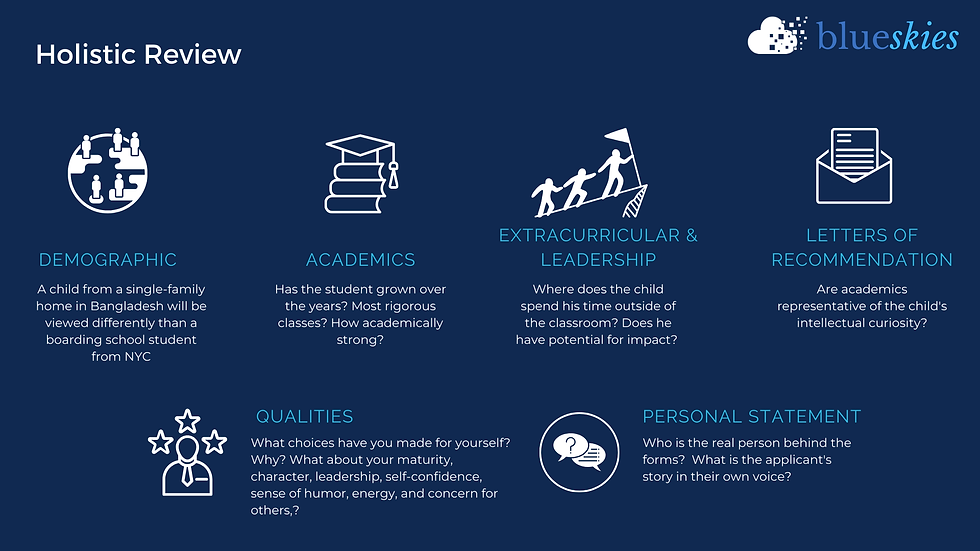
This is what’s known as the holistic review—a complete, contextual analysis of the applicant. Here’s what’s on the checklist:
Academic trajectory – Have you taken the hardest courses available? Are your grades improving?
Extracurricular & leadership – How do you spend your time outside the classroom? Did you participate in nationally or globally recognized competitions like ISEF, IMO, or Google Science Fair?
Personal qualities – What do your choices reveal about your character? Do you demonstrate initiative, resilience, humor, or compassion?
Context & background – Your environment matters. A student from a single-parent home in Bangladesh is viewed differently than one from a prep school in Manhattan.
Teacher recommendations – Do teachers describe you as a classroom driver or a passive participant?
Personal essay – What’s the story only you can tell?
Behind the Scenes: How the Process Actually Works
Let’s demystify Harvard’s internal process:
Harvard buys names and scores from testing agencies like the College Board.
Officers conduct outreach across all 50 states, visiting over 130 cities.
Each application receives:
A 1–2 minute academic scan.
A 4–10 minute full review by 1–4 readers.
Assignment to one of four “buckets”:
Bucket I: Strong admit
Bucket II: Toss-up (gets committee review)
Bucket III: Likely reject (aka LMO = Like Many Others)
Bucket IV: Definite reject
Admissions staff score each applicant on:
Academics
Extracurriculars
Athletics
Personal rating
Letters of recommendation
School support
The final class is balanced by academic interests, geography, talents, and even projected yield—who’s most likely to accept the offer.

So Why Do Certain Indian Schools Like TISB Get More Admits?
Great question. Schools like TISB (The International School Bangalore) tend to send more students abroad because:
Their academic curriculum is rigorous.
They offer richer extracurricular support and external partnerships.
Their environment creates competitive clusters where success breeds success.
So, What Can You Control?
You can’t control your passport, your gender, or your competition. But you can control your presentation—your application strategy.
And the key is: Don’t be LMO. Don’t blend in. Be memorable, not merely perfect.
Final Thought: You Are Not a Template
There is no single formula to get into Harvard or any top U.S. college. What they want is a mosaic, not a mirror. If you’re applying to study abroad in the USA as an international student, stop chasing perfection. Instead, craft a real, strategic story—a story only you can tell.
If you're feeling unsure or want expert help to get it right, book your free college admissions consultation now. Book a call here.
Or better yet, sign up for our newsletter so you are always in the know!
U.S. College Admissions Process: Frequently Asked Questions
How does the U.S. college admissions process work step by step?
Applications go through an initial academic screening, followed by a holistic review that evaluates extracurriculars, essays, recommendations, and personal qualities before final committee decisions are made.
What percentage of college admissions is based on academics?
Academics typically account for 70–80% in the initial evaluation, but once that threshold is met, other factors like extracurriculars and personal qualities carry significant weight.
. What is holistic admissions in U.S. colleges?
Holistic admissions means evaluating the entire applicant, including academics, extracurriculars, essays, recommendations, and background, rather than relying only on grades or test scores.
How do admissions officers review applications?
Applications are reviewed in stages: a quick academic scan, followed by a deeper evaluation by multiple readers, and then categorized into decision groups before final committee review.
Why do strong students still get rejected from top U.S. colleges?
Many applicants meet the academic threshold, so decisions depend on distinctiveness, impact, and personal fit, not just perfect scores


Comments