
How One STEM Extracurricular Can Strengthen Your College Application

Updated: Apr 14
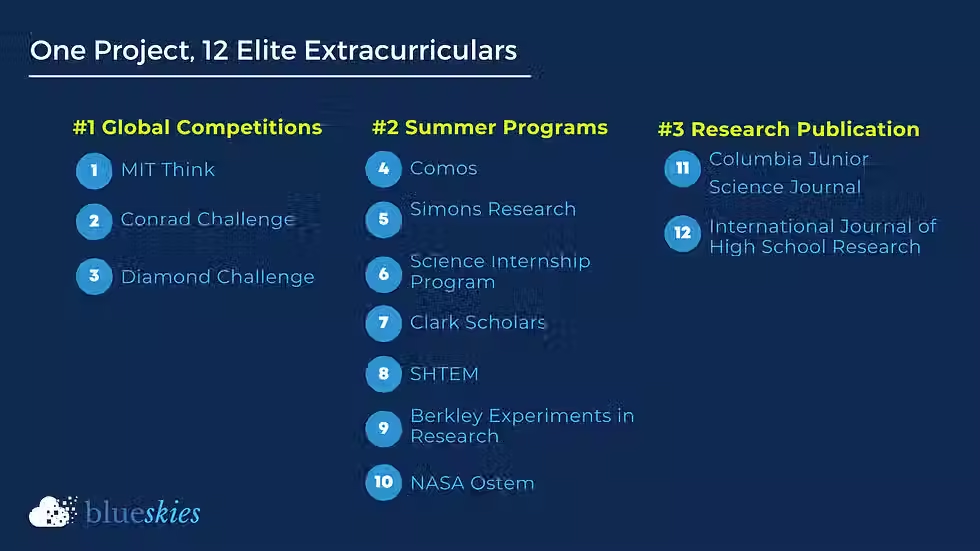
This is the extracurricular that opened twelve elite activities. Below, you’re looking at one student project — and everything it unlocked.

From this single project, the student became eligible for top competitions, selective summer research programs, and even research publications — without stacking activities or doing ten different things.
In this blog, I’m going to break down exactly how this worked — not in theory, but structurally — so you can follow the same plan, save time, and become eligible for a dozen high-ranking activities.
How He Built A Killer STEM Profile in 6 Months
What makes this worth paying attention to is the timeline. All of this happened within about six months. He started ideating in September/October. And he could submit to all the competitions and summer programs between January and March.
The point here is not to do ten projects. It’s to be smart about the one you choose. In this case, one well-chosen project in 11th grade turned a profile that was mostly school clubs into something with real potential — credible enough to apply to highly selective programs and competitions within six months.
Now apply the same pattern earlier. One strong project in 9th grade. One in 10th. One in 11th. You don’t reach the top in year one. Each year builds on the last — more skill, better judgment, stronger execution.
That’s why outcomes improve over time. Every year, your submission is more competitive so you have better odds of recognition and therefore higher probability of real wins.
What Arnav’s Project Actually Is – A Real STEM Competition Submission
Before I explain Arnav’s project, one distinction matters.
The topic didn’t open twelve elite doors. The structure did. Below, you’ll see that structure mapped out. Arnav’s specific project is on the top row. The repeatable pattern is underneath it. This same pattern works beyond STEM. We’ll come back to that later.

For context - here ist he actual project: Concrete cracks over time. Once cracks form, water enters and structural deterioration accelerates. In the United States alone, repairing crack-related concrete damage costs tens of billions of dollars each year.
Arnav’s project proposed a different solution: it outlined a method using bacteria to strengthen concrete through known chemical reactions. The part people usually get wrong is what kind of project can move this fast – let’s talk about Arnav’s.
Why This Project Selection Method Works Beyond STEM
At this point, people usually ask if this only works in STEM. This pattern isn’t unique to engineering. What matters is not the subject. It’s the structure. I’ve seen the same approach work in economics. One student wrote a research paper on labor-market inequality. That same work was reframed as an innovation proposal for the Conrad Challenge.
Later, it became the foundation for submissions to economics writing competitions like the Harvard International Economics Essay Contest and the John Locke Essay Competition. The student didn’t create new projects each time. He built one body of work and let it travel to many elite submissions. This is independent of the subject.
How Arnav Found the STEM Idea for Competitions
People assume students who win these competitions are geniuses. That’s not how this works. If you look at the chevron chart on screen, this starts at the first step — foundations.
Arnav didn’t start with a breakthrough idea. He started with what he already knew. He leaned heavily on AP Chemistry knowledge from 10th grade — reaction pathways, equilibrium, pH effects, and precipitation reactions. It was applied coursework.
The second input was published research. During the fall of 11th grade, he read studies on bacterial self-healing concrete, understood existing methods, and identified their limitations. The idea was then pressure-tested with his AP Chemistry teacher and a family friend who was a chemical engineer.
From the start, there was a hard constraint. The project had to be executable with school resources and mentor guidance — not university labs. No paid programs. No special access.
Don’t be fooled - This wasn’t the only idea on the table. It was the one that had the most potential. Let’s review how you can analyse an idea’s potential.
Why Arnav’s Project Has Real Admissions Value
A common reaction at this point is: this looks like a lot of work. Why not join a structured research program? Why not work under a PhD in a lab? Those paths feel safer. But they don’t create the same leverage.
In this project, Arnav had full ownership. He defined the hypothesis. He chose the materials. He designed the experimental setup. He decided how to iterate when things didn’t work — and how much risk to take. He wasn’t assisting on someone else’s research. He wasn’t executing a preset program.
Because the core knowledge was his, the work could be reshaped. Reframed. Reused – simply by applying different lenses to the project.
If this structure I showed you in section 2 creates leverage, it should show up in how many places the same work can be used. AND it should work for any academic interest. Does it?
Let’s take a look at the 3 buckets where Arnav’s projects can be repurposed to.
EC Repurpose 1: Tier-1 STEM Competitions – #1–3
Arnav submitted his project idea for 3 competitions.
There are a lot of awards you can apply for aside from the ones I mentioned for Arnav. Take a look at the blog Honors & Awards for a list of 25 examples.
For MIT THINK, the submission focuses on experimental design, validation, and feasibility within a high-school lab setting. The objective is to run your project idea in a real lab with the support of MIT undergrads. This project fit perfectly.
For the Conrad Challenge, the evaluation lens shifted. Conrad is less concerned with laboratory detail and more with why a solution matters. The technical core stayed the same, but the framing changed — infrastructure durability, sustainability, cost reduction, and long-term impact. The judges weren’t being asked whether the chemistry worked. They were being asked whether the solution was worth pursuing.
For the Diamond Challenge, the lens shifted again. Diamond evaluates adoption. It is a business competition. The submission focused on use case, where this fits in the construction lifecycle, and how it compares to existing repair methods on cost and durability. The science supported the idea, but the proposal had to focus on market relevance and implementation.
Each competition evaluated something different. The project met all three without being rewritten from scratch.
If you want a structured way to understand and plan your U.S. application, my course Master the Admissions Game walks you through it step by step. It combines 11 video lessons with 31 practical downloads and frameworks you can use immediately.

EC Repurpose 2: Top Tier STEM Research Summer Programs – #4–10
One of the biggest misconceptions about elite summer research programs is that you need a published paper to apply. You don’t. What you need is proof of research direction. That’s what this project provided.
Arnav applied to all 7 of these summer programs on the screen. None of them need a final paper but all of them want to know that you have experience in research.
COSMOS looks for demonstrated research interest. Acceptance rates hover around ten to fifteen percent. This project already showed sustained focus and feasibility.
Simons Summer Research Program is more selective — closer to three to five percent. Prior research exposure is expected.
Science Internship Program (SIP) screens for clear research direction. This project already had a defined problem and experimental plan.
Clark Scholars Program looks for independent research readiness. Ownership matters here — not lab affiliation.
SHTEM requires research interest, not a full proposal. Acceptance rates are higher, but the bar for seriousness is still real.
Berkeley Experiments in Research focuses on early research engagement. Again, direction matters more than polish.
NASA OSTEM varies by role, but technical and research interest is a baseline expectation — often with acceptance rates below ten percent.
This single project qualified the student to apply meaningfully to all seven of these programs. That’s seven doors — without a paid research program, without lab access, and without rewriting the work. Arnav has now submitted 1 project idea to 10 elite programs and competitions.
EC Repurpose 3: Tier 1 and 3 STEM Publications — #11–12
The next set of doors came from publications. Once a project includes original experimental work and measurable results, it becomes eligible for student research journals. There are dozens of journals for STEM for which this project could have been submitted, but there is one constraint and that is that submissions can’t run in parallel. Each review cycle takes three to four months.
On screen, you’re seeing a range of student research journals, along with their approximate selectivity. By the way, if you want the full logic of how research feeds into admissions decisions at top schools, there’s a separate blog called Forget Olympiads — This is Less Competitive & But Gets You Into the Ivy League.
Arnav could have submitted to any of these. Instead, we made a sequencing decision. He first submitted to a highly selective journal — roughly a ten percent acceptance rate. The paper met the technical bar, so it made sense to try the most selective option first.
Why move to a higher-acceptance journal on the second submission? Because at that point, the objective changes. We wanted a clear outcome within about eight months so he could move on to the next publication. If a paper hasn’t been accepted after multiple review cycles, it’s usually a signal.
Our choice of journal was based on managing time, feedback, and probability — not chasing labels.
That’s two additional doors.
Add competitions.
Add research programs.
Add publications.
That’s how you reach twelve — without creating twelve different projects. By the way, not all of these doors are equal in the eyes of admissions.But that’s not what this video is about.
This is about leverage.
Using one strong idea across multiple demanding activities that admissions actually values — instead of putting ten times the effort into ten disconnected things.
These outcomes build on each other. Random activity stacking doesn’t.
And if you don’t yet understand why depth matters more than volume, I break that down in a separate video on why Harvard rejects ninety-nine percent of applicants called Harvard Rejects 99% of Perfect Students — We Analyzed 140,000 Applications.
Takeaways: Why Admissions Depth Over Activity Stacking
This approach only works if the project itself is strong. Not broadly interesting. Not ambitious on paper. Strong. That means a problem that is specific, technically sound, and worth pursuing — backed by research, iteration, and real decision-making. Submitting one AVERAGE project to multiple competitions doesn’t create leverage.
In this case, early validation at the school level mattered. It confirmed that the idea, execution, and framing were solid enough to scale outward. From there, the same project produced multiple, independent outcomes — competitions, research programs, and publications.
The work didn’t multiply. The opportunities did. That’s when one extracurricular becomes enough.
Extracurriculars & US College Admissions – Common Questions
What extracurriculars do Ivy League colleges look for?
Ivy League admissions look for depth, ownership, and real decision-making rather than the number of clubs. A single project that leads to competitions, research programs, or publications is stronger than stacked activities with no clear direction.
Can one extracurricular help in US college admissions for international students?
Yes. One well-structured project can qualify a student for elite competitions, selective summer research programs, and publications, which are signals U.S. admissions value more than participation lists.
Do I need paid research programs to get into top US universities?
No. Admissions prioritizes research direction and ownership, not paid lab access. Projects built with school resources and mentor guidance can be equally competitive.
How to get into Ivy League as an international student through research?
Students succeed when a project shows a clear problem, method, iteration, and impact, and is then repurposed across competitions, summer programs, and journals.


Comments