
How Different Ivy League Colleges Evaluate Applicants.

Updated: Apr 30
If every Ivy League university read your file at the same time… which one would reject you first?
Harvard?
Yale?
Princeton?
By the end of this Blog, you will know the answer. We’re going to analyse 4 student profiles and discuss which universities accepted and rejected them and why. And I am going to explain what personality represents each college’s brand.
The closer your personal characteristics fit with the college’s personality, the more likely you are to get that acceptance. But before we go into the rejections and admissions of our students – let’s set the context. We will talk about fit, yield and culture. If you are short on time, fast-forward to the Admissions Decisions.
What Is Fit and Yield in U.S. College Admissions?
Yield rate is the percentage of admitted students who actually enroll. Harvard’s yield is around 80–85% — if they accept 100 students, about 85 show up. Cornell, on the other hand, is closer to 50%. That means one out of every two admitted students says “no thanks.” And if half the students walk away, the brand stops feeling elite.
So what do colleges do? They protect their yield by admitting students who are likely to choose them back. Yield fuels prestige — a strong yield makes a school look desirable, stable, and ranking-worthy. Now you might be wondering: what does “fit” have to do with yield?
Here’s the real story. Roughly 50,000 students apply to a single Ivy every year — and most of them also apply to all the others. Plus Stanford. Plus MIT. Because with the Common App, applying to another top school takes almost no extra effort. But you can only pick one.
So when an admissions officer looks at you and thinks, “This student could get into MIT,” they assume MIT becomes your first choice. Meaning if they admit you… you’ll probably say no. And that tanks their yield. So what happens? They reject you.
Not because you’re not strong — but because you don’t look like someone who will commit. In other words, “fit” is often admissions-speak for: “We think you’ll choose us back.”
Now — all of this will really click when you see real examples. Stay with me. In this video, we’ll look at four actual students, who gets accepted, who doesn’t, and why. Watch all four cases, because only then will you start spotting the invisible patterns behind Ivy League decisions.
The Ivy League Archetypes and Cultural Fit
So what is each Ivy League’s fit playbook?
• Harvard: the multiplier — someone who makes everyone around them better.
• Yale: the independent thinker — voice-driven, curious, self-propelled.
• Princeton: the specialist — deep mastery, consistency, discipline.
• Columbia: the driver — thrives in chaos, moves fast.
• Brown: the creator — unconventional, exploratory, risk-tolerant.
• Penn: the builder — practical, systems thinker, outcome-focused.
• Dartmouth: the connector — community-centered, loyal, cohesive.
• Cornell: the grinder — resilient, grounded, problem-solving.
Every file that lands on the admissions officers’ desk is weighed against the fit culture. Princeton doesn’t just admit “smart” kids — everyone applying is smart.Princeton has to admit the type of smart that fits its brand. If Princeton filled its unconventional risk-takers, the school’s culture would shift.And that would change the brand that next year’s applicants are drawn to.
So fit protects the brand.
Okay so now that you understand why fit protects an Ivy League’s brand, hopefully it makes more sense conceptually on why you may get rejected even if you are the perfect candidate on paper — but regardless, let’s get into the meaty part of this video and look at how fit can affect real admissions decisions.
The Admissions Decisions — Real Students, Real Rejections
We are going to play a little game and analyse the profiles of 4 students and tell you which colleges accepted them and which rejected them and why. It’s going to get juicy now.
Student A – The Visionary
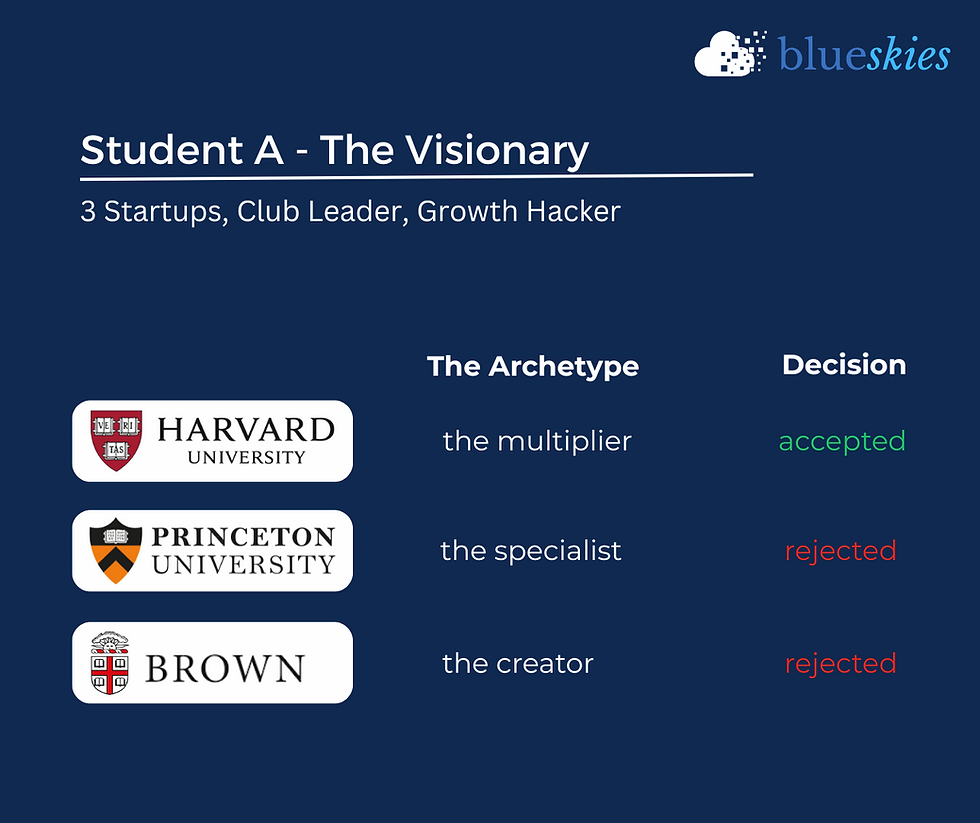
Student A is a classic visionary.
She runs three startups, leads every club, always scaling something.
She’s confident, polished, and wired for growth. Here’s how the room reacts.
Harvard says yes. Remember – Harvard archetype is the multiplier — someone who makes everyone around them better. They love students who create ripple effects wherever they go. Harvard wants the energy of someone who’s already leading — the kind who walks onto campus and immediately builds something. That’s their brand — leadership, scale, visibility. This student fits perfectly.
Princeton hesitates. They’ll say, “Impressive, but is there depth? Has she stayed long enough with any one idea?” Princeton values mastery — they want someone who goes deep, not wide. They get nervous around students who seem spread too thin.
Brown smiles — and then pauses. They love her spark and independence, but they’ll ask, “Is this genuine curiosity or résumé inflation?” Brown’s radar for authenticity is sharp — they’ll pass if it feels too packaged. If the student doesn’t value authenticity, then they also would not be particularly drawn to Brown.
Plus Brown knows that if Harvard accepts her, she’ll choose Harvard.
That’s a yield risk. So Brown quietly passes — partially because they had some doubts about her profile fitting their culture but also because she doesn’t look like she’d say yes back.
So even though the same file walked in the door, it reads differently at every Ivy League table.
Student B – The Thinker

Now meet Student B.He’s quiet, reflective, writes about philosophy and ethics on multiple national publications.
Yale says yes. They love that independent voice — someone who thinks in original patterns. Yale’s culture prizes intellectual identity over polish. They’re building a class of thinkers who will debate ideas at 2 a.m., not chase awards.
Columbia hesitates. They’ll say, “Smart kid — but can he handle the pace?” Columbia is New York energy: fast, practical, relentless. They respect thinkers, but they prefer doers who can turn thought into impact.
Penn asks, “Where’s the measurable outcome?” Penn loves execution — they want to see how ideas become results.They’d respect his intellect, but without a tangible project or result, he feels incomplete in their eyes.
So again — same student, same brain — three different reactions.Because each school is reading for fit.
Student C – The Builder
Student C is all execution. Built a civic app. Grew it to real users. Raised funds. Everything is results, metrics, measurable proof.

Penn says yes immediately. This is their language — strategy, structure, systems. They want people who turn ideas into deliverables. Penn’s brand is the student who builds things before they graduate.
Cornell also says yes. They like grounded problem-solvers — people who make practical improvements, not theoretical ones. If you’ve built, tested, and learned something hands-on, Cornell feels like home.
Yale pauses. They’ll say, “Yes, but where’s the inner voice? What did he learn from it?” Because Yale doesn’t just read for impact; they read for reflection. Without that introspection, they’re not convinced it’s a fit.
So once again, fit separates yes from maybe.
And that’s not randomness — that’s yield and brand protection.
Each school is picking the students who sound like they already belong there.
Student D – The Connector

Finally, Student D.
She’s the glue of every group she joins — captain of debate, MUN chair, event organizer, always bridging people and ideas.
Dartmouth says yes instantly.
They love students who build community — people who strengthen the fabric of a small, tight-knit campus. They want warmth, loyalty, belonging. And that’s exactly what she radiates.
Brown says yes too. They appreciate empathy and collaboration — someone who leads by connecting, not commanding. She fits Brown’s culture of cooperative learning and open exchange.
Harvard hesitates. They’ll say, “We already have many student leaders like this — does she redefine leadership in any new way?” They admire her, but they’re looking for transformation, not repetition.
So what do we learn from these four students and the admissions decisions? It’s finally not about just who’s most impressive when it comes to elite U.S. colleges because they also need to consider how to maintain their rankings.
It’s about who fits the story each school is trying to tell.
Ivy League Personality Archetypes Recap
• Harvard: the multiplier — someone who makes everyone around them better.
• Yale: the independent thinker — voice-driven, curious, self-propelled.
• Princeton: the specialist — deep mastery, consistency, discipline.
• Columbia: the driver — thrives in chaos, moves fast.
• Brown: the creator — unconventional, exploratory, risk-tolerant.
• Penn: the builder — practical, systems thinker, outcome-focused.
• Dartmouth: the connector — community-centered, loyal, cohesive.•
Cornell: the grinder — resilient, grounded, problem-solving.
Each brand needs to remain consistent: to attract the next generation of students who can help it maintain its culture. Because when students enroll happily, yield stays high — and the brand stays strong.
Takeaways — Understanding Fit in U.S. College Admissions
So let’s zoom out. When you understand fit, you understand one of the decision factors in the admissions process of elite U.S. colleges. By the way, I have another video that goes through the details of acceptance rates and SAT scores of all the Ivy Leagues. Check it out in the link.
If colleges are looking for fit — what does that mean for you? It means stop trying to be everyone’s favorite. Start becoming one school’s unmistakable fit. That’s how you stop blending in. Because at the end of the day, the rule never changes:
Fit matters — because it ensures yield, rankings and brand consistency.
And fit… is what gets you in.
Still have questions? Book a call here.
Or better yet, sign up for our newsletter so you are always in the know!
What does ‘fit’ mean in Ivy League admissions?
Fit refers to how closely a student’s personality, interests, and trajectory align with a college’s culture and values. It also signals whether a student is likely to enroll if admitted, which directly affects yield.
Why do Ivy League colleges reject strong applicants?
Because admissions decisions are not based on strength alone. Colleges reject students who appear more likely to choose another Ivy, even if they are highly qualified.
Is college fit more important than grades?
Grades are the baseline. Fit becomes decisive once academic standards are met, especially at schools with acceptance rates below 5%.


Comments