
Academic Myths About Ivy League Admissions (Grades & Transcript Explained)

Updated: Apr 15
Does a single B hurt you, or does a 1600 guarantee acceptance? Most families assume academic evaluation is black and white. It isn’t. Most students have very little understanding of what actually makes up the academic evaluation beyond GPA and standardized tests, and that misunderstanding quietly kills strong applications every year.
In this post, I’m breaking down thirteen academic myths and I explain what admissions is really evaluating when it reviews your high school transcript.
I also have individual strategy guides for Harvard, MIT, Stanford, Cornell, Columbia, and Penn. You can check out all college-specific posts here.
Section 1: Performance Myths in Ivy League Admissions
Your numbers don’t mean what you think they mean. Let’s start with performance myths — the ones about GPA and test scores. These are the myths that cause the most stress, and the most bad decisions.
Myth 1: “A High SAT Can Compensate for Weak Grades”
A very high SAT shows raw ability. But when it sits next to weak grades, admissions doesn’t see the talent you proved on a single test — they see risk. Schools like Harvard University are not looking for students who peak on one day. They’re looking for students who perform consistently, week after week, year after year.
So the question admissions asks is simple: if this student has the ability to score at the top end of the SAT, why isn’t that ability showing up across four years of coursework?
A strong SAT confirms raw talent. It does not excuse weak grades. This post will help you with strategies to score better on the SAT.
Myth 2: “One B Ruins My Chances”
A single B does not ruin your chances. Admissions officers are not counting individual grades — they are looking for patterns. An isolated B, even in an easier class, is usually a non-issue.
What matters is whether grades show consistency, improvement, or decline over time. One data point does not fail the academic read. Patterns do.

This is also why two related beliefs are false. Junior year is not the only year that matters, because admissions evaluates performance across all four years. And one strong semester does not prove readiness, because consistency matters more than a short peak. Admissions is not judging moments in time. They are judging sustained performance over time.
Myth 3: “A 1600 Is Meaningfully Better Than a 1530”
Once you’re above a certain score range, admissions stops splitting hairs. A 1530 already tells them you can handle the academic workload. A 1600 does not suddenly make you more ready for college.
What matters far more is where your score sits relative to the school’s typical admitted student. This leads to a critical rule: you must clear the median, not the minimum. Being below the 50th percentile is risky because admissions does not want to admit students who may struggle once the workload intensifies.

Above the median, higher scores stop functioning as a differentiator. In very close comparisons, a 1600 may marginally reinforce confidence, but it rarely decides an outcome on its own. By that stage, admissions is weighing rigor, consistency, judgment, and overall profile strength — not a few extra test points.
At the top end, SAT test scores qualify you. They don’t separate you.
Myth 4: “Everyone With Perfect Scores Gets Into an Ivy League”
Harvard University receives over 50,000 applications for a class of about 2,000 students. Thousands of those applicants have near-perfect grades and top test scores, and most of them are still rejected. In fact, roughly 76 percent of admitted students graduate in the top two percent of their high school class. That tells you something important: strong academics are common at this level.

Elite colleges are not building a class based on grades alone. It is building a balanced cohort — with leaders, researchers, artists, community builders, and future specialists across many domains. At this level, perfect academics don’t make you exceptional. They make you eligible. And eligibility alone does not guarantee a seat at the table. This post on how Harvard scores 140,000 applicants will help you understand the entire admissions process.
These 4 myths are known as performance myths. The takeaway: Numbers don’t win you admission. But they do decide whether your application is taken seriously — or filtered out early. I also have a youtube video on why Perfect Grades Aren't Enough.
By the way, if you want a structured way to understand and plan your U.S. application, my courses walks you through it step by step. It combines video lessons with practical downloads and frameworks you can use immediately.

Section 2: Rigor and Course Choice Myths
Once your grades and test scores are high enough, admissions already knows you’re capable. The question is no longer how smart you are — it’s whether you make good academic decisions.
Course difficulty and the capability to handle an aggressive academic load reveal judgment: whether you chose challenging classes or safe classes, whether you made smart trade-offs, and whether you understood what college-level work actually demands.
This is where many strong students quietly hurt themselves. If you want more details on how to pick your A-Level courses, check out this blog. Let’s talk about the 5 most common myths around rigor and course choice.
Myth 5: “All Grades Are Treated Equally”
An A is not just an A. Admissions weighs grades based on what the course actually demands. An A in a demanding, cumulative subject like advanced math, science, or writing carries more weight than an A in a lighter course.
Admissions officers are not guessing about difficulty. They know which courses are considered rigorous, which are moderate, and which are lighter across boards, schools, and tracks. When a more demanding course is available and a student chooses the easier option, that choice itself sends a signal. If you are an international student, this post on the best IB subjects to take will be helpful.
That is why two students with the same GPA can be evaluated very differently. And at many selective schools, certain courses are de-emphasized or even removed when academics are evaluated. Classes like physical education, basic life skills, health, or introductory electives don’t meaningfully signal college-level readiness.
Myth 6: “All As Mean I’m Academically Strong”
All As do not automatically signal academic strength. They only have meaning in the context of the classes you chose. All As in the easiest track available often signal risk aversion, not readiness.
Admissions looks at the level of challenge you selected when harder options were available. Strong academics require both performance and difficulty — not one without the other.
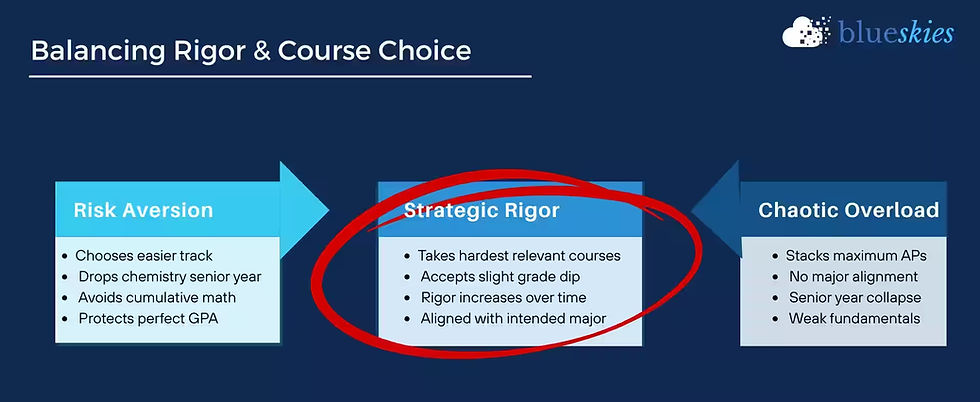
Myth 7: “I Should Protect My GPA by Avoiding Hard Classes”
This is one of the most common mistakes strong students make. Avoiding rigor to preserve grades often backfires at selective schools. A slightly lower grade in a demanding course is frequently viewed more favorably than a perfect grade in the lowest track.
That’s because rigor isn’t just about difficulty on paper. It’s about whether you chose challenge when easier options were available, whether you handled multiple demanding subjects at the same time, and whether your academic load prepared you for sustained college-level work.
Admissions is evaluating judgment. And choosing challenge when you had the option matters more than optimizing for safety.
Myth 8: “APs Automatically Strengthen My Profile”
APs do not automatically strengthen your profile. They only help if they clearly demonstrate college readiness, and that depends on three things.
First, subject choice. Random APs don’t signal strength — they signal box-checking. Second, performance. An AP only helps if you do well both in the class and on the exam. Weak scores or shaky grades often do more harm than good. Third, balance. APs should not come at the expense of your fundamentals or your extracurricular depth.
Many Ivy admits take 6 to 8 advanced courses — but they’re admitted for how they handled them, not for the number itself. If you are an international student considering whether or not to take AP classes, check out this post here.
Myth 9: “It’s Okay to Take 9th Grade Light — I’m Adjusting”
Admissions does not expect perfection from day one. But they do expect seriousness from day one. Hundreds of applicants are performing consistently from the start, and that becomes the baseline you’re compared against.
Early struggle followed by clear improvement is usually acceptable. It doesn’t automatically hurt you. But starting easy by choice — lighter courses, minimal challenge — and staying there sends a different signal. That’s not adjustment. That’s opting out.
Admissions looks for difficulty increasing over time, but they also look at who took academics seriously from the beginning. Ninth grade isn’t a warm-up year. It’s the starting line.
If you’re wondering how an Ivy-level academic profile actually differs from a strong but average one, I walk through that comparison step-by-step in a separate blog.
Section 3: Coherence and Alignment Myths
Once rigor is evaluated, admissions asks a different question: does this academic profile actually prepare the student for what they claim they want to study?
Colleges admit students into specific academic environments, so they look for the right foundations. Economics without math signals risk. STEM without writing signals incomplete preparation. Humanities without quantitative work signals narrow readiness.
Some applicants are rejected because the choices don’t align with the path the student is claiming they want to study.

Myth 10: “I Don’t Know My Major Yet, So I’ll Take the Courses My Friends Are Taking”
You don’t need to be one hundred percent sure about your major in ninth grade. But you usually have some sense of what interests you — whether math engages you, whether science excites you, whether writing comes naturally or feels like a struggle.
When students choose courses passively or randomly, they do two things at once. First, they close off future options without realizing it. Second, they signal a lack of ownership over their academic decisions.
At a minimum, your course choices should help you learn something about yourself. Taking stronger math helps you test whether economics, engineering, or science is realistic. Taking rigorous writing helps you assess readiness for almost any major.
This stage isn’t about locking in a path. It’s about making intentional choices about your subjects that give you information — and show admissions that you took responsibility for your direction.
Myth 11: “If I’m a STEM Major, I Don’t Need Writing or English Rigor”
Being strong in STEM does not excuse avoiding writing. And at most schools, English is not optional — students are expected to handle heavy reading, writing, and analytical communication regardless of major.
College-level STEM is not just about solving problems. It’s about explaining ideas, writing clearly, defending arguments, and communicating complex work to other people. When a STEM student avoids rigorous English or writing courses, admissions doesn’t see focus. They see an incomplete academic profile.
Schools are admitting students who can go deep in one area while still functioning across disciplines. Depth is expected. Balance is required. You don’t have to love writing. But you can’t opt out of it.
Section 4: Structural Filter Myths
Once academics, rigor, and coherence are evaluated, admissions applies a new lens — they look for strength across disciplines. A profile with a major imbalance signals you may be a risky admit. Strong academics with weak extracurriculars suggest limited initiative or leadership. Exceptional extracurriculars with weak academics suggest potential burnout or academic struggle once the workload intensifies.
Here are our 2 structural risks.
Myth 12: “Strong Academics Can Compensate for Weak Extracurriculars”
Strong academics are expected at selective schools. It’s a baseline. They help you clear the academic bar, but they do not replace what extracurriculars are meant to show. Grades and test scores demonstrate readiness; extracurriculars reveal initiative, leadership, impact, and how you choose to engage beyond the classroom.
Those qualities cannot be inferred from academics alone. This is why applicants with excellent grades and scores are routinely rejected when their extracurricular profile is thin or generic. Academics qualify you. Extracurriculars are what differentiate you.

Myth 13: “An Exceptional Achievement Can Compensate for Weak Academics”
Some students argue that this changes if the achievement is exceptional — an Olympiad, a global award, major recognition. At selective schools, that does not lower the academic bar. It raises it.
Exceptional achievement signals very high raw ability. When that sits next to weak academics, admissions does not see balance — it sees inconsistency. The question becomes simple: if this student has the ability to perform at the highest level, why isn’t that showing up consistently in the classroom?
And if you want to see how strong students still get rejected, I’ve analyzed real Harvard admissions cases in another blog.
Final Takeaways: What Ivy League Academics Actually Filter For
If you remember nothing else from this video, remember these five truths.
First, academics are a filter, not a differentiator. Strong grades and test scores don’t win you admission. They decide whether your application is even taken seriously.
Second, consistency matters more than peaks. Admissions is not impressed by short bursts of performance. They are looking for sustained effort across years.
Third, rigor is a judgment test. Choosing challenge when easier options exist matters more than protecting a perfect GPA.
Fourth, coherence matters. Admissions evaluates whether your academic choices make sense together and reflect intentional decision-making, not passive or random selection.
Fifth, nothing compensates for a structural weakness. Strong academics cannot replace weak extracurriculars, and exceptional achievements do not excuse weak academics. Imbalance is read as risk.
If you plan academics strategically, early and intentionally, you reduce risk. This isn’t about gaming the system. It’s about understanding it — and making academic decisions that hold up under scrutiny.
From here, check out the blog on how an Ivy League extracurricular differs from a top 50 college extracurricular.
Still have questions? Book a call here.
Or better yet, sign up for our newsletter so you are always in the know!
Commonly Asked Questions About Ivy League Academic Evaluation
Do Ivy League schools care more about GPA or SAT/ACT?
First find out whether your college is test blind. If not, then they care about both, but they read them together. A strong test score can confirm ability, but it cannot erase inconsistent coursework performance over four years.
How many Bs can you have and still get into an Ivy League school?
There is no fixed number. Admissions evaluates patterns, context, and rigor. A few Bs in very rigorous coursework can read differently than a clean transcript in the easiest track.
Do AP classes matter for Ivy League admissions?
Yes, but not automatically. APs help when they align with academic direction, show sustained rigor, and are matched by strong performance in both class grades and exam scores.
What is the biggest academic mistake strong applicants make?
Avoiding challenge to protect GPA. At selective schools, course choice is read as judgment, and consistent rigor is often valued more than perfect grades in easier courses.


Comments