
It's Not Just Your GPA & SAT Score | The Real Academic Formula Behind Ivy League Admissions
- Tina Chulet
- Feb 24, 2025
- 6 min read

Updated: Feb 2
International Student Guide
Academics is a Number – HIT IT
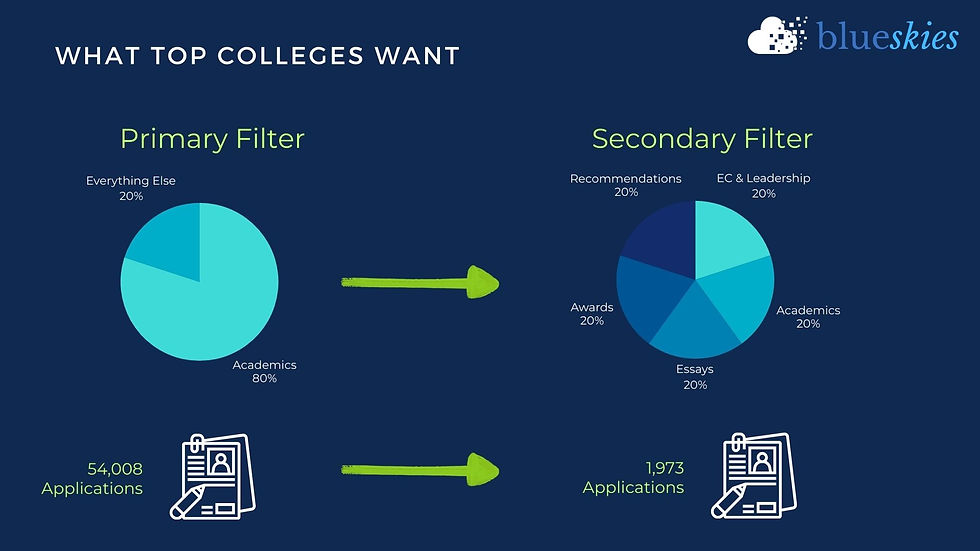
To be frank, there isn’t much to say about academics when discussing your overall application strategy for US college admissions for international students. And that is because—there isn’t much to say. Get the numbers to qualify. Either you do or you don’t.
Every university will have the 25%, 50%, and 75% cutoffs for grades and SAT/ACT scores. You need to be above the 50% mark if you want to have a better chance at the school. For those wondering how to get into Ivy League as an international student, strong academics are non-negotiable.

Still, I see more and more students ignoring their academics. Suddenly, everyone is focused on building up their extracurricular profile—the best extracurriculars for US college applicants—but at the expense of their core academics. The big mistake is ignoring your academics in favor of extracurricular achievements. Remember, robust academics are one of the key components of effective college profile-building strategies for top US Universities.
Student Examples
I had two students last year who were extremely enterprising. One started a bakery business, and another launched a foundation for upskilling women. From an extracurricular standpoint, they were really ahead of their peers—showcasing exactly what what extracurriculars do Ivy League colleges look for?—and had clearly made sure they were not LMO (Like Many Others).However, they forgot about their academics in the meantime. One was scoring a 1100 on her practice SAT, while the other, after acing practice exams with 1500+, took the real exam and got a 1380.
Guys, you need to nail your academics. Because as it stands today, these students don’t meet the academic bar—unless they get incredibly lucky. There’s a good chance that even with stellar extracurriculars, the admissions readers might not even consider your profile if your academic scores don’t measure up. Remember, with 45,000 applications for some universities and 160,000 for the University of California system, there just isn’t enough bandwidth to thoroughly review every application. This is a core lesson in any US college admissions guide for international students.
Reiterate College Stats
We’ve hit these numbers already, but it’s important to reiterate them. And just so it’s clear, let’s look at some top schools:•
In 2024, 29 universities accepted less than 10% of applicants.•
In 2024, from a list of 112 well-known reputable schools, only 30 had SAT scores of less than 1300.•
For those who applied to Harvard in 2022 (42K applicants), 8,000 had a perfect GPA. For anyone asking, "How can international students get into Harvard?" remember that academic excellence is critical.
Of the 67% who reported class rank for Harvard class of 2024, 74% of them reported being in the top 2% of their class academically.
Okay, so did I hit you over the head enough times?
Nitty Gritty
Let’s dive into the four components of academics and what exactly they mean—this is vital for effective college profile-building strategies for top US Universities.
Course Quality
Progression: Have you taken progressively challenging courses?
Number of Courses: More isn’t always better—but a robust course load can impress.
Which Courses: Focus on core subjects (e.g., Math, Science, or even Art) that align with your intended major.
Curriculum Rigor
Did you take challenging options?
Did you self-study (for instance, preparing for an AP exam)?
Did you enroll in any classes outside of school to boost your profile?
Grades
What was the grade value for each class?
What was your overall grade average?
What was your class rank?
Standardized Testing
Your ACT score
Your SAT score
Your AP scores
Your IB/Cambridge score

Student Example – Making Choices
One of my students was deciding between MATH AA HL and MATH AI HL. For those not familiar with the IB curriculum, the AA track is significantly more challenging. She was very certain that she wanted to take AI because she wanted an easier school experience. First of all, your admissions readers are experts on these courses. They know exactly which courses are difficult and which are not—so don’t try to game them. You won’t be able to.
My student made the wrong choice. She should have selected the most difficult math.
She was interested in the top 10 schools. She always needs to take the most difficult classes available.
She was interested in a major of Economics. Math is considered a prerequisite for economics.
My student was taking limited science courses. Thus to prove she can handle numbers, she should have selected the more rigorous AA track was advisable.•
My student was also taking the easy Business Studies. Since Business Studies is known to be relatively easy, choosing AA ensures that her course rigor remains competitive.
Should I Take AP Classes?
Some students ask me if they should enroll in AP classes. You may have heard of “AP”—AP classes are high-level courses in the USA system (non-IB/Cambridge). When I was in 12th grade, I took six AP classes while still enrolled in school.
Reasons to take AP classes
Since CBSE curriculum is not considered to be comparative at an international level, the AP courses test your capability against global courses.
Since high-level Computer Science and Psychology are not available in IB or IGSE, it is helpful to show your interest in the topic when you are applying for the major. e.g. If you want to apply for a psychology major, then taking AP Psychology shows your dedication.
Reasons not to take AP classes
The higher-level courses (HL) in the IB curriculum already provide a rigorous alternative.
If you aren’t in the top 10% academically, adding AP classes might not boost your profile.
If your extracurriculars aren’t strong, you might need to focus there instead.
Many preparatory schools in India have students who self-study and excel in AP classes. If you’re a rockstar with ample time, go ahead and take them. But if not, I’d rather you aim for a Tier 1 extracurricular activity than overload on AP classes outside of school.
Final Score Requirements
So what does that mean for you if you want to get into the top 20 schools—those with less than a 10% acceptance rate? Drum roll please: You need either:
A score of 41+ on certain standardized tests, or
An A* in 3 subjects, and
A 95-98% score in CBSE.
For anyone exploring Ivy League admissions for international students – step-by-step or searching for the best U.S. universities for international students, these score requirements are critical.
What Do You Mean by Honors & Awards?
There’s one more section—Honors and Awards. Most of my 12th graders are shocked when this section appears because you cannot leave it blank! Starting in 9th grade, think about what award you can win every year of high school.
The "Common App Honors Section" appears under academics but can also include non-academic awards. There are enough spaces for 5 awards/honors.
Academic Scholar or Honor Societies
Publications
Awards at competitions
Outstanding Achievement Awards
Athletic Character Recognition Awards
Awards at the local, state/regional, or national level
Remember, any national award is highly regarded—and international awards are even more impressive. Be careful with common awards like "Honors Roll." In the U.S. alone, there are 37,000 high schools. Imagine if, in America, even 10 students from each high school receive the “Academic Excellence Award” annually—you’re looking at 370,000 students with that award. Suddenly, your application gets lost among the many.

For those interested in free U.S. college admissions help for international students, this detail is crucial when crafting your application profile. Start early, and if needed, book a free U.S. college consultation to refine your approach.
Takeaways
Nail the Academics: They’re your foundation for US college admissions for international students.
THIS IS SUPER HARD: Excellence isn’t optional.
Academics Before Extracurriculars: Don’t let your extracurricular pursuits overshadow your core academic performance.
Don’t Forget Your Competitions/Awards: They bolster your profile, but only if paired with strong academics.
Every Grade Matters: From 9th grade onward, it all adds up.
Standardized Tests Are Not Optional: Whether you choose the SAT or ACT, these scores are critical for your profile.
Challenging Coursework: You cannot fool the admissions readers, who are experts in college profile-building strategies for top US Universities.
If you’re serious about how to get into Ivy League as an international student or simply want the best guidance on US college admissions for international students, remember that your academic record is your strongest asset. And if you need more help, book a free U.S. college consultation today to get personalized advice on your journey.
Stay tuned as I upload more content or feel free to dive straight into one of these links.
Book A Free 30 Min Call
Book A Free Call for 30 Minutes: https://bit.ly/4k9T8xn
Social Media Resources
Instagram: https://bit.ly/41rp4Gb
Youtube: https://bit.ly/4gQmUEw
Online Course
Online Strategy Course: https://bit.ly/4k9T8xn


Comments