
Which Ivy League Should You Apply To? (Acceptance Chances Explained)

Updated: Apr 14
Which Ivy League is the Best Match for You? If you want to boost your chances of admission, you should know the answer. Some Ivies reward raw intellect. Others care more about creativity or leadership. So… which one is right for YOU?
In this blog, I’ll break down the unique personality of each Ivy League college — what kind of students they love, what they secretly prioritize, and how you can match your application to the right university. If you’re aiming for the Ivies, this could be the difference between rejection and acceptance. Because let’s be honest — it’s not just about being ‘smart enough.’ It’s about the University also choosing you because they think you fit into their college’s culture.
Even if you're applying as an international student, understanding this could make or break your chances. Fit is often more important than prestige. Let’s jump into fit before we talk about the students that each of these Ivy Leagues is most likely to admit.
Why “Fit” Matters More Than Prestige in Ivy League Admissions
The truth is that the “Ivy League” colleges are all good in their own ways, but they deserve to be evaluated individually, not as a lump group.
Selective universities, and particularly highly selective universities, have a high enough yield so do not have to worry about filling their class each year, or with retention or graduation. They can afford to mold their entering class into one that best suits the needs of the university (not the students).
It’s important, though, to remember that colleges aren’t just looking for top students. They are looking at students individually, trying to find students who will fit their specific mission. That means enough students that can pay full tuition and room and board (legacies and others of means), enough students in the various majors, enough students who can play football (or other sports), enough great heart-warming stories (for PR), enough special talents (for PR, and for the marching band and orchestra, and so on), and enough students who will choose them over others who accept them (to have as high a yield as possible). Scan through this post on MIT which clearly defines how admissions selects an overall class.
That’s why it's so important to align your application with what each Ivy actually values. If you miss that, even a perfect GPA won’t help. If you’re distinctly different from the type of student who typically attends a specific college, even though it meets all the other criteria that you require of colleges on your college list, you should think twice before applying.
You can check out this video, I explain why some Ivies reject strong applicants — and how understanding college personality can protect your application.
General Patterns Across the Ivy League
• Harvard/Princeton/Columbia lean more toward elite academic awards or highly passionate applicants deep in one interest.
• Brown/Dartmouth/Yale care more about fit, values, and intellectual curiosity.
• Cornell/UPenn often like applied achievers – those who’ve shown practical initiative in research, business, or engineering.
And if you're not sure which one fits your strengths, you're not alone. This is why I always say—college profile-building strategies are not one-size-fits-all. Stayed tuned and get the insider information on which Ivy League you have a better chance of getting admitted at.
I’ve linked a free guide here that shows how strong college profiles are built strategically, not randomly. Download this free guide for profile building here.
This post will give you an inside view into what U.S. colleges actually want—and how to craft your best shot, especially if you're figuring out how to get into Ivy League.
So let’s go through all 8 Ivy Leagues.
Best fit for Princeton University: The Academic Purist
Check out the Princeton specific guide here.

Here are some basic stats:
Princeton (like Cornell) is most STEM focused of all the Ivy colleges. For students who care about the hard sciences, engineering, mathematics, Princeton is a good fit and a large majority of its students are pursuing STEM-related areas. You should check out how you can upgrade your STEM extracurriculars here.
Princeton is considered highly intellectual as defined by the emphasis on theory as opposed to application in its academic coursework and offerings. Princeton will look at grades and expect perfection-even 1 or 2 B’s might filter a student out of the process.
Princeton cares a lot about research and in fact, every undergraduate must write a thesis, regardless of major.
Princeton, like Harvard, loves awards. So, try to win some important awards especially in research or your field of academic interest.
Princeton especially emphasize depth over breadth especially in your subject area– that is why applying without a major to most Ivy Leagues is risky.
Best fit for Harvard University: Academic Excellence + Personal Qualities
Check out the Harvard specific guide here.

Harvard (like Yale and Dartmouth) leans in toward Humanities. Government, political science, and economics are popular majors at the university where students flock to management consulting, public policy, and investment banking roles.
Harvard, like Princeton, prioritizes academics (GPA and course rigor are deciding factors on whether your application even gets fully read-expect that 4.0 is the standard to be evaluated for Harvard). If you don't know how academics are evaluated, check out this post.
Like Princeton, Harvard prioritizes students who have achieved major awards. Without going down the rabbit hole of all the awards they like to see here, you can easily imagine what these are in some cases—Regeneron/Intel, major math competition, etc…
Harvard will look at personal qualities and evaluate students heavily based on recommendation letters, assigning scores to those qualities
School support-Harvard will look for whether a student is supported by his/her school (often through rec letters and awards won at school)
Best fit for Yale University: Leadership, Humanities, and Intellectual Curiosity

Check out the Yale specific guide here.
Yale has a focus on political science, law and the humanities. Students are intellectually curious, bright and well rounded across the board. Similar to Harvard and Princeton, students tend to flock to management consulting and investment banking roles after college. Student body exhibits a strong degree of leadership and has access to professors who are at the top of their fields.
Though international & national awards are not required, but high-quality creative or leadership output is valued
Yale values extracurriculars in performing arts, debate, and international outreach
Best fit for University of Pennsylvania: Pre-Professional and Applied Achievers
Check out the Penn & Wharton specific guide here.

Upenn has a focus on pre-professional programs, including Wharton undergraduate business college, Jerome Fisher M&T, Digital Media program, etc. The student body is characterized by its particular affinity toward entrepreneurship as exemplified by the founding father Benjamin Franklin’s values.
Dual-Degree Programs: UPenn offers a variety of dual-degree programs that enable students to combine different fields of study, such as the Huntsman Program (international studies and business) and the Jerome Fisher Program in Management and Technology (management and engineering).
Penn loves students who have preferences in business, STEM, social innovation
Combine academic excellence with real-world application (internships, startups, nonprofits)
Like Cornell, Early Decision is the way to go at PENN. It helps to apply early and offers you a greater chance.
Like Dartmouth, having a sports background can be helpful in getting into PENN.
By the way, if these lists is confusing you more, I offer detailed online courses that walk you through every part of the admissions process. Plus, I have exclusive downloads that give you access to over 450 scholarships — both domestic and international — to help you finance your education."
Okay 4 more Ivy Leagues to Go!
Best fit Cornell University: Engineering Powerhouse with ED Advantage
Check out the Cornell specific guide here.
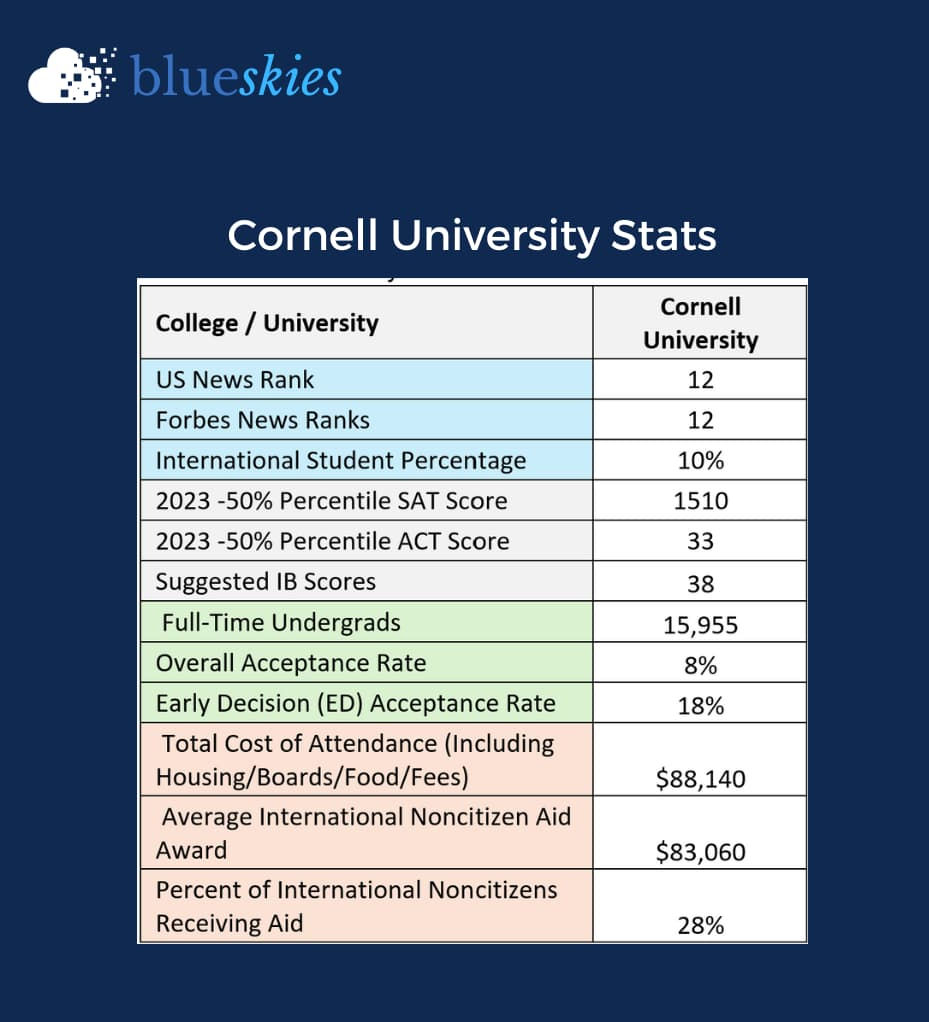
Cornell is the strongest engineering and computer science program of the Ivy Leagues. Incredibly rigorous academic institution that has access to world class resources. Cornell has unique programs including Colleges of Arts and Sciences, Engineering, Architecutre, Art and Planning and the School of Hotel Administration.
Cornell is the largest of the Ivy Leagues with a class size of 3,200
If you are a biology major, Cornell is a great choice along with Upenn and Brown.
To get into Cornell, Early Decision is the way to go.
Because of its remote location and unique “loner” standing among the Ivies, Cornell loves to see the love from students to ensure they will attend if offered a spot
Cornell is the most egalitarian of the Ivies with the most socially mobile students.
Best fit for Columbia University: Core Curriculum and Global Intensity
Check out the Columbia specific guide here.

Columbia is well-known for the Core Curriculum, where students receive a truly well rounded liberal arts education including contemporary civilization, literature, writing, art, music and the frontiers of science. Students are also enrolled in the Fu Foundation of Engineering and Applied Science (SEAS).
Columbia’s students are extremely hardworking and a bit more stressed than other Ivy students.
There is a culture of competition at Columbia, which is odd considering students and the university pride themselves on intellectualism and a passion for the liberal arts and CORE program. Less pre-professional than PENN and much more intellectual, getting into Columbia requires highlighting a fit with one of two schools—Columbia College (Columbia’s school of arts and sciences) or the Fu School of Engineering and Applied Science.
Columbia loves students who Academically intense, globally-minded, often politically or socially engaged; if you have interests in journalism, performing arts or are involved in social advocacy, it is a bonus.
Though not quite as intense as Harvard or Princeton’s desire for awards, Columbia does value national-level recognition (especially in writing, activism, or STEM
Columbia definitely favors certain schools as “feeders” over others. So, if your school is not a feeder and does not have a history of sending students to Columbia, you might be better to opt for another Ivy. And if you are in NY already, they do hope to see that you have forged some connection with the university before applying.
Best fit for Brown University: Open Curriculum and Community Impact

Brown University will look for free thinkers who have moved mountains through community service. Brown is known for its exceptional teaching and its community outreach organization is one of the largest groups on campus. Brown cares immensely about community service and open-mindedness. Working to make a major impact on your community is needed. Think in terms of people helped, the difference made and numbers that are impactful.
Brown is defined by the Open Curriculum, where students could have the flexibility to take an eclectic set of courses to satisfy their distribution requirements and also design their own concentration should they pursue it.
Brown is less focused on awards and rewards strong, self-driven projects or niche interests
Brown is known as the “happiest” Ivy with liberal, creative progressives
Best fit for Dartmouth College: Undergraduate Focus and Community Fit

Darthmouth is the smallest Ivy at only 1200 students in their undergrad class with an extreme commitment to undergraduate teaching. In fact at one point, even the current college president, Dr. Phil Hanlon taught introductory calculus.
Because of its location in rural northern NH, Dartmouth engenders an unusually strong sense of community. Hanover is Dartmouth and vice versa. There's no where to drift away from the campus.
And again, because of its location, it champions the outdoors (like Princeton)
Dartmouth will also lean into filling spots on athletic teams.
Dartmouth, above the other Ivies, will prioritize foreign language.
Key Takeaways: How to Choose the Right Ivy League for You
As you can see, the truth is that the “Ivy League” colleges are all good in their own ways, but they deserve to be evaluated individually, not as a lump group. Thus getting asked, how come Columbia University and UPenn are not considered as elite as Princeton and Harvard – is kind of silly. All have a fantastic quality of education but yes perhaps their international brand differs. So if elite to you means the best education the world has to offer, then all are in the same boat.
But here's the tension: students often focus only on rankings—without understanding fit. In US college admissions, that’s one of the most common and costly mistakes.
In fact Columbia and Penn offer many educational opportunities that are not available at Harvard, Yale or Princeton. Moreover, they are located in vibrant urban areas which also offer many more educational opportunities than the suburban Princeton, small-city Yale and isolated Cambridge.
It’s not just about prestige—it’s about positioning. The best strategy? Match your personality and interests to the college’s unique culture. Check out this post on additional details of how Ivy Leagues maximize their applicant choices.
So when you are thinking of which Ivy League you should apply to, make sure you looked up the specifics of the college! And try to match the fit that those colleges look for.
If you're unsure where to start or which Ivy fits you best, I offer a free college admissions consultation and you can Book a call here.
Or better yet, sign up for our newsletter so you are always in the know!
Common Questions About Choosing the Right Ivy League
Which Ivy League is easiest to get into?
None are “easy.” but Penn & Cornell are the largest with the most open seats. Each Ivy admits students who fit its institutional priorities. Applying to the right Ivy for your profile will give you a larger boost than applying across all 8.
Does Ivy League fit matter more than rankings?
Yes. Ivy League admissions focuses on mission alignment, class balance, and yield—not just rankings or prestige.
Do Ivy League colleges prefer different types of students?
Absolutely. Some Ivies prioritize academic awards and research, others value creativity, leadership, community impact, or applied achievement.
How should international students choose which Ivy League to apply to?
International students should prioritize fit, financial aid policies, feeder history (e.g. have they previously accepted students from your high school), and institutional priorities—not brand alone.


Comments